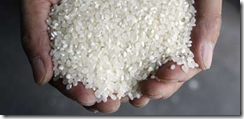
 Rice rationing has begun to bite in Britain and the US only a couple of days after my post on food security.
In Britain rice is being rationed by shopkeepers in Asian neighbourhoods to prevent hoarding. Tilda, the biggest importer of basmati rice, said that its buyers — who sell to the curry and Chinese restaurant trade as well as to families — are restricting customers to two bags per person.
It is the first time that US retailer Wal-Mart, the world’s biggest retailer which owns Asda, has introduced rationing in the US. While Americans suffered some rationing during the Second World War for items such as petrol, light bulbs and stockings, they have never had to limit consumption of a key food item.
I hope international food aid programmes will be able to reach those most desperately in need, and that we as individuals will support food aid appeals. I personally want to do something of value to help. All I can do right now is write about it and voice my concerns, and hope that something will turn up where I can be more proactive in making a difference, to help families like these highlighted in today’s Times:
Lake Naivasha camp, Kenya
Virginia Ndungu, a 55-year-old mother of eight, watches her daughter stir a blackened pot of cornmeal gruel in front of a tent in a refugee camp where they have lived since January (Nick Wadhams writes). This is tonight’s meal, and there will be no bread, no meat, and no tea.
Camps like this are the front line in the global crunch over rising food prices. “I have nothing, not even ten cents – how can I afford sugar for porridge,” said Ms Ndungu, who farmed chickens but was displaced during Kenya’s postelection violence.
Brasilia, Brazil
Like hundreds of shoppers who crowd into Guara market on the outskirts of Brazil’s capital, Brasilia, Antonia da Souza complained about the startling increases in the cost of food (Gabriella Gamini writes). “The price of rice has doubled, bread too. Tomatoes have tripled and black beans are 30 per cent more expensive,” she said. “I would have to spend three times as much I used to six months ago to get my weekly shopping needs, but salaries have not gone up so I can only half fill my shopping basket.”
Bombay, India
Every morning the price of milk sends Shankar Vemula into a state of despondency. Mr Vemula, 40, a driver, lives with his wife, five children and his parents-in-law in a tiny one-room house. “Our morning litre of milk now costs 35 rupees (45p),” Mrs Vemula says. Three months ago it cost 18 or 20 rupees. The cost of everyday staples has soared. A bunch of spinach used to cost one or two rupees in the market, now it is seven or eight rupees, Mrs Vemula says. Brinjal, or aubergine, an Indian favourite, is now 30 rupees per kilogram – six months ago it was 15 rupees.
And in Britain:
Melksham, Wiltshire
It is mid-morning and the car park of the Aldi supermarket in Melksham, Wiltshire, is almost full. The German chain is benefiting from increases in food prices, welcoming customers who previously shopped at Sainsbury’s or Somerfield.
Paul and Tracy Jones are new faces at Aldi, having driven six miles from their home in Corsham. They have a monthly food budget of £400 for themselves and their three children. Paul said: “We have definitely noticed the increase in food prices. Everything has gone up, even here. We are paying 30p to 40p more for a chicken than we were a year ago.”
*I have no idea how a family of five can live on £400 food budget a month, I would find it impossible. My boys and husband turn their noses up at anything that has Tesco Value stamped on it.
Have you any idea how much you spend on food each month?
I know i don’t do any proper food shopping yet but i have noticed the effects. I used to be able to buy a chocolate bar for 30-32p and it’s now more like 55p and crisps have increased around about the same too 🙁
There is no comparison what so ever between Tesco so called value rubbish and what Aldi sells for the same or better price.
Food bills here (Em & I)
07-08 £1535 / year
06-07 £1339
05-06 £1792
04-05 £1260
Total of last 10 years £20344
Emily, I have noticed food prices rising too over the last year, and soaring fuel costs have hit us badly as we live in a village.
How are students like you and David going to survive on your loans? Eggs have gone up too, and pot noodles, as well as a bag of chips, everything that forms part of a regular student diet.
Geoff, are you saying that on an average of £1,500 a year, you are spending only £125 a month on food for two? Around £32 a week? A large chunk of my money goes on good quality fruit juices because we don’t like the concentrated crap. And good quality meat,fish and cheese is not cheap. I can easily spend £30 a week at the butcher alone.
P.S. Geoff, I agree with you about Tesco, our nearest Aldi is in Cambridge, maybe should I make a special shopping trip there instead. I know you are a big fan.
Excellent post Ellee!
I am amazed at Geoff’s food bill….. I shop aldi and tesco and ice lands …… use some value stuff too never any friut juice or wine….bill per week is never under 70 pound.we eat meat but could not afford butcher prices.
Mybe having teenage boys is the problem….
Geoff’s food bill would be more if he included all the food i take up at week-ends 🙂
Rachel, thank you.
Sally, I buy my meat from a butchers shop run from a house in my next village and the quality is superb and the prices much lower than supermarkets. The meat is virtually all sourced locally. Unfortunately, his bbq packs have just gone up from £20 to £25, but that does include 2lb rump steak, as well as chicken drumsticks, ribs, pork burgers and 2lb home produced sausages.
Try giving up meat its really easy to do. Remember meat is a major contributor to global warming, starvation, land use and requires about X6 the energy contribution of non meat food.
We’re pretty frugal, and definitely use up all leftovers. The issue about the food crisis is, of course, we in the west will be OK, rationing or not, those in the Third World have the potential to be staggered by it, and if you want political upheaval, just let famine occur. It bodes badly.
We use Lidls for the bulk of the shop and have saved around £200 per month (now £400 for 4). It is striking that there are now posh cars in the Lidl car park too now.
I notice that the Commons will still be using bottled water:
http://www.order-order.com/2008/04/let-them-drink-tap.html
Prince Charles has 16 polo horses, 5 chefs and his boys gallavant around in Chinooks.
MEPs have been hiding away their expenses claims (surprise surprise).
These people make me sick.
Further:
Our local council have sanctioned a Sainsburys in our town. Our town is listed as disadvantaged. Why not a Lidls instead of us all driving 12 miles to save money ?
Backhanders somewhere along the line no doubt.
I will NOT be lectured by politicians or cossetted BBC executives on the environment. I don’t eat as much as they do, I refuse to drink bottled water, I drive and economy car, have a small house and I haven’t flown or been abroad for 5 years.
These events seem quite unthinkable.
I agree with Geoff – save money and feel better.
Having said that I think we might, sadly, be on the verge of a tragedy of epic proportions globaly.
We have to remember that the decision whether we buy food in Lidl or Tesco is a privileged decision; some people simply cannot afford to buy food… for their kids or themselves.
It’s getting worse for those in third world countries. This announcement has just made by the United Nations press office:
SOARING FOOD PRICES JEOPARDIZING UN’S ABILITY TO FEED THE WORLD’S HUNGRY New York, Apr 24 2008 4:00PM The accelerating rise in food prices worldwide is threatening the work of the United Nations World Food Programme (WFP) to feed the millions of hungry people around the globe, the head of the agency said today.
“We can buy 40 per cent less food than we could last June with the same contribution,â€? WFP Executive Director Josette Sheeran said in a video conference from Rome, voicing concern that as many as 100 million people face being pushed deeper into poverty.”
In countries where people subsist on less than $1 per day, many have cut back on meals, only eating several times per week.
Furthermore, there is the additional challenge of adequate supply, with up to 40 countries now imposing export bans on food, impacting importing countries, which are most impacted by the food crisis.
Those most at risk are children and mothers; refugees and internally displaced persons; pastoralists; and the urban poor.
Despite the higher prices farmers can get for their products, many do not have access to credit or any form of support and are therefore unable to afford the inputs required and must plant less.
In Kenya’s Rift Valley, non-IDP farmers are planting only one-third of what they did last year due to soaring prices of supplies such as fertilizer.
It has suddenly become quite scary indeed. I’m sure two teenaged boys eat you out of house and home. I remember it well.
Blame it on biofuels
Great stuff, Ellee – you’ve put meat on the skeleton here.
Wal Mart is an embarrassment to me over here in the USA. Such morons. I have to admit that the rice situation only came to my attention yesterday.
Food rationing? Yep, Bio fuels. Could be a good thing in this country – in the war we were encouraged to grow our own. Now we eat junk food. Actually I could do with a bit of rationing around my home as I stepped on the scales the other night and am getting on for 12 stone… ARGHHH! Soon I’ll only be able to fit into towels.
I remember being staggered in 1973 when I went grocery shopping for my new husband and myself. I had to spend $35.00 Cdn for 2 weeks worth of groceries and I thought THAT was outrageous. I’m quite careful in my food buying, but even though I now only buy for myself, it still can run around $100.00 a week. And I don’t buy wine or liquor, soda pop, or candy!
Amazing, that. There’d be riots here if pasta or rice were rationed. I spend about 70 € a week on food [not including 2 lunches a week out at 15 euros each.] That amount does not include what I spend on bottled water [because I prefer it, not because the tap water is undrinkable – about 2 euros a week and a neighbour kindly brings it for me.] Add dogfood and salumeria, too.
This is very true here in Australia, where a similar pattern is in place. We noticeably more for most things, particularly fruit and vegetables, meat and dairy. Some of these are impacted by the local effect of the drought, but haulage costs must be sky rocketing. We spend about $200 a week on food for two adults and two kids.
Everything I have seen or read suggests that this is every bit the crisis you mention. I was particularly struck that a large US retailer, with unlimited market power was rationing rice.
We spend about £75 a week on shopping for two vegetarians but that includes food for 4 cats and non edibles.
Major food exporters such as Australia and Ukraine are experiencing the effects of drought, showing how climate change can trigger future food crises.
Water scarcity contributes to food scarcity, and, as the Intergovernmental Panel on Climate Change has pointed out, billions of people are at the risk of water stress by the end of the century unless carbon emissions are slashed and urgent adaptation actions are taken.
[…] Ellee has a great thought provoking post on food rationing here and in the USA, as well as highlighting the rather silly choices we have when we shop. […]
Excellent post Ellee, someone recently suggested that a change in Chinese eating habits may have something to do with rice shortages, don’t know how true it is.
Between £80 and £100 for two people (depends on how many visitors etc). That includes all the Tesco Shopping plus meat from the local butchers an fruit and veg and one or two other things from the local butcher shop.
I know the price of rice has doubled this year
Not strange really that we could be held to ransom by the availability or lack of staple crops world wide.
Fortunately we are affluent enough that we can afford a doubling of food prices or sustain a switch to other staple crops – potatoes, etc
But if there is a world shortage of more than one crop, and countries like China & India, or Africa decide to feed their people rather than sell their crops for dollars …
we could be faced with ‘real’ food shortages in the west, or price increases that will bite into our pockets and raise the inflation index even higher than house price rises.
But hey food riots in the 21st century?
Would the government send the army to shoot the rioters in the uk and France – just like they used to do in the past.
Wouldn’t it be funny if the affluent west
got ‘starved’ out, literally
by developing nations
because of our overdependancy on food imports.
Mind you neither Palestine or Israel are self-sufficient in food, and if imports of staple diets become more expensive or scarce – I guess we will all be faced with the dilemma of which section of society gets fed first.
It could actually be a good thing, you know to see self-preservation kick in.
No good invading Iraq and securing supplies of Oil, if you can’t get food. But hey if China is having to pay for Oil in dollars, it is only natural China should want more dollars for its (surplus?) rice.
Elle, Another gorgeous day
Hope you are enjoting a sunny weekend.
Life is good (even if the price of rice is up)
We live in the UK.. and feed ourselves plus 2 adult children very well on £350 per month.
Bogoff offers, selective shopping, a range of supermarkets , a Freecycle deepfreeze (free of course), and knowing the price of all common domestic items are a help.
No chocolate, few cakes, bulk buying of offers and of course zero – like zero- waste.
Mass eating of meat is neither healthy or cheap.
When I read of soem budgets in the UK exceeding ££100 per week per head,,, etc I wonder what people eat.
Of ourse we have Home Bargains ( basically offers are 33% of list price (not “off”, “of”), Lidl Aldi, Morrisons, Asda Tesco etc. Tesco are the most expensive as any discerning shopper knows .. except for Sainsbury and the Co-op. Somerfield have cheap Andrex toilet roll offers.
We reckon to save £70 per month due to offers.
Selective shopping is all.
And of course we have frozen raspberries free.. home grown. And we do eat quails’ eggs – home grown..
“*I have no idea how a family of five can live on £400 food budget a month, I would find it impossible. My boys and husband turn their noses up at anything that has Tesco Value stamped on it.”
Well there’s your problem. You’re married to a snob and have brought up snobs. Supermarket own brands are a fact of life for us normal people. My family of four spends less than £200 per month on food and we never go hungry so an extra £200 to feed one extra mouth doesn’t sound very hard.
I’ve enjoyed these comments, many thanks.
Christine, you are right about the snobbish bit, sometimes Tesco Value is ok, like their tinned peaches, and other times it isn’t. If it is something I like, I buy it regardless of what the others think in my house.
I spend approx $1000Aud a month on food and we don’t eat like kings. Hardly any treats, lots of fresh fruits, juices. No biscuits or things like that, if I do, it is rare. Bread here in Australia is over $3 a loaf if you miss out on the cheaper ones and milk is $3-50 to 6 for 3 litres. Even minced beef once was considered poor man’s food is expensive. This is for 4 boys under 11 and 1 adult, two male cats. It includes all household things like loo paper, laundry powder and with some items I buy the no name things and it still costs me the same amount.
i agree about Tesco value – I buy quite a lot of value things but it depends what it is. We try and spend no more than £50 a week for two of us and two animals but it’s usually more than that. I dred to think about howmuch we’ll have to spend.
We spend about £500-600/month for a family of 4.
I have a few larger sized bags of rice as well as a load of cans of food as an emergency food supply. I don’t think people realise how quickly – given optimised supply chains – the shops would empty of food in an emergency. My wife complains to me about the space it takes up.
Some countries (Switzerland ) make it a duty to have an emergency reserve of food in the house – and a Nuclear fallout shelter in the Swiss case ( may have changed since the end of the cold war ).
We should remember that there have been years when world crops have failed – as during the eruptions in Iceland in the 18th century ( which could easily happen again ). I bet the government doesn’t have food to feed the population for a year.(There are after all no votes in it ).
Alfred, thanks for sharing your view on this, your family seem to be very astute shoppers, as we all need to be these days. I believe that what you are saying about the loo rolls and tissues is true, btw. Glad to hear you have proved it mathematically!
[…] Ellee Seymour on food rationing […]