Ellee Seymour

MCIPR, PRESS CONSULTANT, JOURNALIST, POLITICAL AND PR BLOGGER.

November 30th, 2009

Copenhagen talks must not stall like Doha

I’ve been closely following the Doha trade talks as my MEP Robert Sturdy, who as vice-chairman of the Inter-Parliamentary World Trade Organisation Committee, has played a key role in these negotiations.

I know his frustrations only too well as year after year, world leaders fail to reach an agreement. Today we issued another press release voicing concerns that the latest talks this week will once again fail to be productive. image

America holds some of the ace cards in reaching an agreement for these talks, which started in 2001 and are intended to lower trade barriers around the world to encourage free trade:

Robert warned:

"There is growing desperation around the world for a deal which would boost all of our economies, but particularly those in the developing world. It seems that everyone at the meeting wants to talk about Doha, except for the USA.

"A deal may seem far-fetched at the moment but it will become impossible unless the EU flexes its muscle and stands up for liberalisation of global markets. If the USA resorts to protectionism, the EU will follow, and the results for global trade will be devastating."

We can’t allow nations to behave the same way at the United Nations climate change conference in Copenhagen next week.

image Economist Sir Nicholas Stern, author of the Stern Review on the Economics of Climate Change, and environmental activist George Monbiot share my concerns about these crucial talks being dragged out the same way as Doha, and are urging world leaders to work collaboratively.

The  great difficulty is that different nations have their own agendas, and self-protectionism often kicks in when countries panic if they are struggling in any way.

The world will be watching President Obama,  hoping he will heed the decisive words of Sir Nicholas who in today’s Guardian urges world leaders to see the bigger picture:

Do we collaborate and act to reach a strong political agreement that both decisively cuts the devastating risks posed by climate change, and rapidly opens up the opportunities offered by low-carbon economic growth? Do we in that way set ourselves to overcome poverty and promote prosperity? Or, do we give way to narrow, short-term interests, quarrelling, lack of ambition and delay, thus allowing the risks to the climate to grow to dangerous levels which will derail development in both rich and poor countries?

Given what is at stake, essentially the future peace and prosperity of the planet, world leaders must now recognise that Copenhagen is the most important international gathering of our time. A strong political agreement can and must be reached in Copenhagen. There can be no excuses for failure.

November 29th, 2009

How the NHS should clean up its act

Today’s alarming report on the Dr Foster Hospital Guide about our under performing image NHS trusts – based on a range of indicators including death rates, infection rates and staffing levels – reminded me of something worrying I learnt at the Infection 2009 conference earlier this month.

Dr Peter Wilson, consultant microbiologist at University College London Hospital, told me that because of insurance reasons, cleaners image were only allowed to clean walls, floors and tables in the wards. Nurses were expected to clean everything else which had been in contact with the patient, and often in their own time, which naturally they were reluctant to do.

“Take the case note trolleys, they are never cleaned,” he said.

“We need to change the way our hospital cleaners work in the UK. We need a new breed of cleaner, one who is trained to clean all high contact surfaces immediately around the patient.

“It’s because of the insurance culture, in case somebody presses a wrong button, but they could be trained to learn about this. We need somebody to take up the banner.”

I met a trainee nurse at a party last night who told me their ward sister told them not to clean anything in the ward, that it was down to the cleaner. However, the cleaner has a different brief, and this demonstrates a clear lack of joined up thinking which has potentially serious repercussions. The issue cannot be left if hospitals have to clean up its act. Surely this is more important than pushing for our nurses to be trained to degree level, when we are not getting the basics right.

Let’s hope Shadow Health Secretary Andrew Lansley will take up the banner. It clearly makes sense to have fully trained cleaners who can effectively do a job which the public expects of them so nurses can be left to do the job they are trained for.

November 27th, 2009

Have you gatecrashed a party?

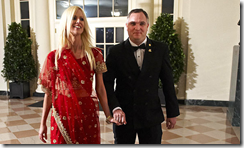
Appearing confident and dressing the part – as well as being daring – opens any doors, as Michaele and Tariq image Salahi discovered when they gatecrashed a presidential dinner at the White House hosted by President Obama and his wife Michelle.

“I belong here too,” is the message this clearly picture tells us. The beaming couple do not look like interlopers.

But how easy is it to get away with? Have you ever gatecrashed a party?

I did once unintentionally, in fact, it was a wedding reception. My husband and I were attending his cousin’s wedding and he dropped me off at a restaurant opposite the church as it was pouring with rain and he couldn’t find a car parking space.

I waited in the bar and one of the waitresses I knew asked me why I was there. I told her I was going to a wedding, and she directed me into a room where a wedding reception was being held.

I helped myself to a glass of bubbly and the room was so crowded that I couldn’t see the happy couple. I couldn’t work out why I was there, whether it was a pre-wedding drinks party. After a while, the bride came over and asked, “Excuse me, but do I know you?”

I was so embarrassed, and quickly gulped down the champagne. It’s not every day I go to two weddings in the space of 10 minutes!

I say well done to the Salahis, they will dine on this for the rest of their lives, but it certainly makes one question the president’s security.

November 25th, 2009

Getting to grips with depression

image Depression is one of those terrible illnesses we imagehandle so badly.

Mental illness is sadly still tabooed, and it is only when we hear about those who can no  longer live with their tortured minds and commit suicide, like Germany’s famous goalkeeper Robert Enke, or the beautiful Korean model Daul Kim, that this difficult issue is publicly debated.

But what can be done to help those suffering from depression, those poor, helpless souls who would rather be anywhere instead of plummeting deeper their dark abyss?

These were two young and talented people who seemingly had it all with their successful careers. But they couldn’t cope with their depression, like countless others. Their fame and fortune couldn’t save them.

Tragically, even when you work in the profession, it seems little help is at hand, as this poignant letter in today’s Times describes, written by the bereaved father of a man who was severely depressed:

Sir, Your leading article (“Working minds”, Nov 23) about the need for depression to be accepted in the workplace has particular resonance for my wife and me because we lost our son to a severe depressive illness in 2005. He was a clinical psychologist, but as his illness developed he was desperate to keep it secret from all the mental health professionals who knew him or might have contact with him in the future. He insisted that his career depended on this because there was a strong prejudice in the profession against anyone who had suffered from mental illness: they were perceived as not “tough enough” for the job.

We found this hard to believe — the mental health profession seemed the last place on earth where such attitudes were likely to be found — but we were assured by others that it was so. Not only did this worry add to the burden of an already terrifying illness, whose features are so accurately and movingly described by Giles Andreae in times2, but it made our son reluctant to seek treatment and, when he did seek it, prevented him from making use of good local facilities that might have helped him. The treatment which he did accept was unsatisfactory and, in the end, unavailing.

Surely it is clear that someone who survives a depressive illness is enhanced rather than diminished by the experience, and that the insight which results may be of advantage, particularly in the field of mental health.

Richard Oerton
Bridgwater, Somerset

November 25th, 2009

Insanely protective French parents of Zoe

I’m a protective mum, but not in the insane way as French parents who are furious imagethat the name Zoe has been chosen by Renault for its new electric car. They regard image it as a slur on their daughters called Zoe.

Zoe has become one of the most popular names for French baby girls, rising from somewhere over the past five years to become 17th favourite.

But some angry parents have launched an internet petition demanding that the car should be renamed, to prevent “Zoe” being devalued.

Renault has defended its choice of name, saying the it evoked values of “femininity of youth, a playful spirit and vivacity”.

I have an idea for Renault. Why not name it The Carla after the wife of the French president as she clearly has all the attributes they are seeking for the promotion of their zero emission car.

I’m sure you would sell a lot more too!

November 24th, 2009

Suffolk swedes and apples

First our Norfolk folk were insultingly dubbed the “Turnip Taliban”. And now Conservatives in the neighbouring county of Suffolk who are selecting a parliamentary candidate this Friday have been mockingly lablled the “Suffolk image Swede”.

Hey, why does the media keep insulting our residents this way? I am not alone in asking this question. The East Anglian Daily Times’ headline today points out, “Vegetables are not rooted in Suffolk.” The paper’s political editor Graham Dines reckons:

The implication is that East Anglia Tory members are a bunch of straw sucking, two headed yokels who don’t venture to the bright lights of London and therefore have no idea whatsoever what life is like in 21st century multi-cultural cosmopolitan Britain.

They’re standing in the way of the great David Cameron modernising effort to make the Conservatives liked and electable next year.

It’s natural that local political associations want to exercise their democratic right to select the candidate they feel will best represent them. They should not be insulted for requesting that local candidates are included on short lists along with the other willing wealth of talent that Conservatives have attracted.

If an analogy must be made between Suffolk folk and a local produce, I would suggest they use the apple which Suffolk is famed for with its delicious Aspall cider and scrumptious Copella juice. If it’s good enough for New York – city folk there don’t object to it being known as The Big Apple – then the good natured citizens of Suffolk will surely be able to take that on the chin too.

After one, one bite and you’re hooked; that’s the irresistible appeal of Suffolk.

November 23rd, 2009

Describing life after a head injury

imageThis is one tragic example of how an acquired head injury can dramatically change your life for ever.  Felicity Aston, the polar adventurer and Antarctica scientist, has described the terrible events which followed after her younger brother Spencer, now 21, was in a car crash while at grammar school and predicted good GCSE grades.

This is an extract from her moving account in yesterday’s The Sunday Times magazine:

The Spencer we have now is just as kind and lovely, but he’s different. At the time we were so grateful he’d survived, there was no time to grieve for the person who’d been lost. Spencer had been in a car with some older boys from school; the driver lost control on a corner and collided with another car.

No one was drunk, they all had their seat belts on, but the result was that the front passenger died and Spencer and his friend suffered serious brain injuries. I remember Mum and I walking into A&E in the middle of the night and seeing blood everywhere, then being shown Spencer, who didn’t have a scratch on him, yet he’d scored three on the Glasgow Coma Scale — as low as you get before you’re pronounced dead.

The urge to shake him and say “Wake up!” was overwhelming. We were told there was no brain activity at all. Everyone was preparing us to switch the machines off, but then, after about 24 hours, one of the nurses noticed a slight reaction in one of his pupils and suddenly it was “He may not recognise you when he comes round”. And we were saying: “You mean he’s coming round?”

But that initial burst of optimism didn’t last long. His brain scan was filled with black areas which were haemorrhages — he’d completely destroyed his thalamus. I didn’t leave the hospital at all for the first week. Mum didn’t come home for about a month. We willed him to breathe unaided, to swallow, to lift a finger.

He was given a board with a button to press for Yes or No, and he was so frustrated he kept banging this board: “No! No! No!” All of us thought: “Why Spencer?” He was the apple of everybody’s eye, the focus of so much love. It was more than “Why couldn’t it be me?” It felt so unfair. I’d done stupid things and taken all kinds of risks, but he’d never done anything wrong.

Considering the initial prognosis was that Spencer would remain in a vegetative state for the rest of his life, everyone’s been amazed at his progress. He still has his sense of humour, but his sense of what is or isn’t appropriate has gone. If you imagine every one of your thoughts or feelings being visible on your face, or suddenly blurted out, that’s Spencer.

Because he’s a young man, and he’s very large and direct, people think he’s drunk, and they find him intimidating. We’ve had a stream of eminent specialists here and Spencer will decide within five minutes if he’s going to co-operate or not. If they are patronising he won’t give them the time of day. I make clear to him where the lines are. If he’s being rude to me I’ll tell him. Sometimes he’ll understand and apologise; sometimes he won’t. Because he has a brain injury people tend to be too nicey-nicey with him and that doesn’t do him any good.

This is one reason why I find my work as chair of trustees with Headway Cambridgeshire so rewarding and important; it’s the fact that this kind of accident can happen to anyone without any notice. It can be the result of a fall, an attack or even a stroke or medical complication.

We were fortunate in attracting some very positive responses to my recent appeal for new trustees and I will be meeting some of them this evening.  It’s not too late to apply, so please let me know if you are interested. My press release has also been published on Ann Hawkins’ website; she is the networking queen of East Anglia and has all the right contacts :-)

Pic credit: By Dirk Lindner, Sunday Times.

November 22nd, 2009

How can divorce be made fairer for kids?

imageWith the Conservative Party pledging much needed support for families, it is worth remembering that almost half of marriages in England and Wales end in divorce.

It is surely these fractured families, with children often torn between bitter, warring parents, who particularly need help and support. The impact of divorce on children can be devastating, as this report highlights, including self-blame, rebelliousness and even suicidal thoughts.

Any attempt to reduce the pain inflicted by divorce should be welcomed, and one idea worth trying could be the introduction of compulsory “conflict clinics”, described in The Sunday Times today.

Sandra Davis, a partner at Mishcom de Reya, is spearheading a campaign to get family lawyers and politicians to think hard about how family courts work – or rather, don’t work, – to prevent further cases such as this one quoted below which is cited in the story:

Somewhere on the south coast of England an 11-year-old boy is packing his bags this morning, preparing to move to his father’s house in the West Country. One can only imagine the tearful scenes as he and his mother fold his clothes and sort through his school books.

Last Thursday, despite admitting it would be “almost cataclysmic” for the child, a judge at the Appeal Court in London ordered that the boy be moved from his mother’s care to live with his father, with whom he lived for just a few months after his birth before his parents separated.

They have been fighting over him since. The mother claims to have given her “unconditional support” to the boy having a relationship with his father, but the father told the court he found it “impossible” to build that relationship while the boy was living with his mother.

One of his relatives said it was a very sad situation: “The mother just wouldn’t let go. She yes-ed and no-ed an awful lot and sadly broke promises. But in a horrible situation like this we recognise that it is also very difficult for the mother so it has been no good for anyone, really.”

Especially the boy: the traumatised child has said his father has “ruined his life” and that he would “punch and kick” rather than leave his mother’s home. The judge gave him three days to pack his bags. That time limit expires today.

Sandra believes the court system, with its delays, costs and adversarial nature, exacerbates the bitterness couples feel towards each other and makes it harder for them to come to rational decisions.

Most parents — some 70% — claim to make their children’s welfare their “top priority” during a break-up, but in a study by Mishcon, two-thirds admitted to using their children as “bargaining tools”. It also suggests that nearly one in three children whose parents divorce lose touch with their father. Many children said they felt used, isolated and alone after the divorce.

Sandra suggests establishing compulsory “conflict clinics” where disputes can be resolved.  Under the Mishcon proposals, nobody could make an application to court without a certificate saying they had been through resolution and, for some reason, failed. Sandra suggests that parents be given an incentive to use such conflict clinics by making it twice as expensive to apply for contact orders through the courts than to undergo family therapy. Under such a scheme only the most difficult cases would end up in court.

Another idea is being considered by Shadow Family Minister Maria Miller. She has been looking at Australian “family relationship centres” which offer mediation in divorce, with a view to replicating them here. They assist families to negotiate their way through separation or divorce and support parents to reach agreement on parenting arrangements outside the court system. Group sessions are undertaken to help separating parents focus on children’s needs and facilitate developing parenting plans. 

The worst unresolved cases of divorce and separation can lead to unspeakably cruel and devastating actions, like parental abductions, and even murder. Shockingly, it can also force offspring to take their revenge in the most unbelievable way, like this 18-year-old Chinese girl who murdered her parents and cut them into pieces after an argument with them about their divorce.

Does anyone have any other suggestions about how to reduce conflict during divorce? Does the present mediation system work which is offered by the courts? Not according to Guy Harrison, who is quoted in the Times report. He last saw his daughter eight years ago.

One of Mishcon’s clients, who is now divorcing and has a young child, remembers her own parent’s bitter divorce, particularly as she is now experiencing it herself:

“It was miserable. When they decided to split up I remember my dad crouching on his knees in front of me with tears in his eyes and him telling me that he loved me and he would come to collect me the following Saturday at two o’clock. I waited by the window from nine in the morning.

“The hours passed by, two o’clock came and went and I felt I’d never see my dad again. I was right, I never did.

“Now I have a little boy. I never wanted him to feel how I felt but that has gone out the window as his father and I are going through a divorce. I am doing to him exactly what my parents did to me.”

How many times has this heartbreaking scene been repeated with other families? How can divorce be made fairer for kids?

Pic courtesy of Sunday Times.

November 21st, 2009

Defra’s double waste whammy


Biggins 001

I am a keen recycler, but was astonished to read in the latest PR Week that Defra is paying a PR company £94,000 to launch a recycling campaign for Christmas with the key messages reduce, reuse and recycle.

The government already funds a quango called WRAP – the Waste, Resource and Action Programme – to get these messages across, so why is Defra hiring an outside company as well? No wonder Conservatives have earmarked WRAP for sweeping cuts if it should win the general election.

Quangos, an abbreviation of quasi-autonomous non-governmental organisations, employ more than 90,000 people and operate outside direct government control despite being funded almost entirely from the public purse.

It has been reported that WRAP’s four-strong board of directors shared a half-a-million pound pay packet and £354,000 of taxpayers’ cash was used to make 20 of their workers redundant in a cost-cutting exercise.

Christmas is a key time to promote recyling, but shouldn’t WRAP be leading on this instead of Defra? Does it have the right staff to do this following its swathe of redundancies? If not, how effective is it?

The PR contract has been awarded to Threepipe, and they are using the same key messages – the same three Rs that I was promoting as press officer for local authorities on waste and recycling initiatives eight years ago in the Eastern Region.

One Christmas we were delighted when the loveable actor Christopher Biggins, who was appearing in the Cambridge panto, agreed to this photoshoot to encourage householders to recycle Christmas trees; he did this completely free of charge, out of the goodness of his heart.

The biggest problem with Christmas recycling is that contractors hired by local authorities have long breaks over the festive period and do not clear up the overflowing bottle banks until after the New Year; many recycling centres used to  be closed too, causing an avalanche of complaints in the local press.

I would suggest that Defra follows the three Rs itself by reducing the money it is wasting, reusing its team at WRAP to promote Christmas recycling, and continue to recycle its key messages as figures published this week show that the UK still sends more municipal waste to landfill than any other EU member state.

*Btw, I likedWRAP’s campaign highlighting how much food we waste. Now it’s up to supermarkets to change its special offers to help prevent unnecessary over-buying.

November 20th, 2009

Robert Sturdy accuses EU of “a classic fudge” over top two new jobs

My Eastern Region MEP Robert Sturdy has accused the EU of “a classic fudge” over the appointment of its first president and foreign minister, the two top jobs in Europe.

image imageThe Belgian Prime Minister, Herman Van Rompuy, is the first president elected by European leaders under the Lisbon Treaty, while Baroness Ashton,  former Trade Commissioner, is the newly appointed High Representative for Foreign and Security Policy.

Mr Sturdy worked closely with Baroness Ashton as Conservative spokesman on international trade, and in June 2007 ratified her appointed as Trade Commissioner.

He said:

“Both these appointments are a classic EU fudge. They have appointed two weak people so Merkel and Sarkozy are not threatened.

“Baroness Ashton is a very nice person and was a good trade minister, but whether she is up to this new role remains to be seen. I am rather concerned it is a question of appointing people who are not qualified.

“Belgium has a split government and can’t agree on which language they should speak. How on earth can they agree on Europe? I would have liked to have seen Chris Patten as our president.”

UPDATE: Robert has this morning had an interview on Radio Cambridgeshire and been quoted in The Telegraph. Just had an interview request too from BBC Today in Parliament.