Ellee Seymour

MCIPR, PRESS CONSULTANT, JOURNALIST, POLITICAL AND PR BLOGGER.

Boris 1boris 17boris 16boris 12boris 13boris 15boris4boris2boris 6boris 7boris 9boris 11boris 3
August 31st, 2006

Government warned of "descent into chaos" over revamp of NHS computer

A multi-billion-pound revamp of the NHS computer system is “descending into chaos”, warned MP Richard Bacon.

It is the biggest computer project in the world and has been blighted by technical problems and spiralling costs.

The on-the-ball South Norfolk MP, who was chosen by MPs as Backbencher of the Year for his work in exposing the foreign prisons scandal, has urged the Government to pull the plug on the scheme before it ended up “sleepwalking towards disaster”.

He is a member of the Commons Public Accounts Committee and has called for the controversial programme to be decentralised and for control to be given back to hospitals locally.

Under the government’s plans, GPs, clinics and hospitals across the country would be linked together by computer - allowing appointments to be arranged instantly and giving patients more choice on where to receive treatment.

Richard believes hospital chief executives across the country should instead be given personal responsibility - and funding - for purchasing computer systems locally.

As things stand, the upgrade of NHS computers, the largest IT project in the world, has been dogged by controversy and criticised for over-centralisation. Crucially, it does not have the confidence of clinical staff.

And the programme’s largest software supplier, iSoft, is under investigation by the Financial Services Authority for possible accounting irregularities.

Richard warned:

“The National Programme for IT in the NHS is currently sleepwalking towards disaster. It is far behind schedule. Projected costs have spiralled. Key software systems have little chance of ever working properly. Clinical staff are losing confidence in it. Many local trusts are considering opting out of the programme altogether.

“These problems are a consequence of over-centralisation, over-ambition and an obsession with quick political fixes.

“This programme is costing taxpayers a king’s ransom but it is descending into chaos. Our paper proposes a solution which would reduce the scale, cost and risk of the National Programme and accelerate the delivery of benefits to all NHS staff”.

It was only a short while ago that the Government faced chaos after a new computer system was blamed for delayed payments to farmers, causing hardship and financial ruin.

I don’t understand why this Government can’t install reliable, efficient computer systems that work. Don’t we have the technology? In theory, it sounds helpful to have a national shared NHS database, but can you imagine the chaos it would cause if it crashed?

If the progamme is scrapped, I wonder how much public money has been wasted. How many extra nurses salaries would it have paid for?

August 31st, 2006

Happy International Blog Day

Today is Radio 5 Live is plugging it like mad. They want bloggers to recommend sites.

The aim is also to travel out of your normal comfort zone and explore some new sites. This is a great idea as I do think some blogs are a little clique.

This site tells you how to mark the day, and with 52.6 million blogs to check out, you should have lots of fun today. I shall be joining and and will report back later.

Here are my five recommendations from those I already know, though I enjoy all those mentioned on my blogroll:

I recommend Geoff Jones, who launched me into blogsphere, http://www.geoffjones.com/

Iain Dale, who gives a humorous and punchy review of political news straight from the hip, http://www.iaindale.blogspot.com/

PC Bloggs, a policewoman who gives a great grassroots account of life on the beat, http://pcbloggs.blogspot.com/

Neville Hobson, who is always one step ahead with social media, http://www.nevillehobson.com/

and Margot Wallstrom, if only more politicians could blog like her, though I would like to see a few more posts, http://weblog.jrc.ec.europa.eu/page/wallstrom/

Thanks to my long suffering husband Stephen who heard this on the radio and told me about it, even though last night he was so cross with his late dinner that he threatened to go to Tesco and get something to eat unless I stopped blogging. It’s tough being married to a blogger!

August 30th, 2006

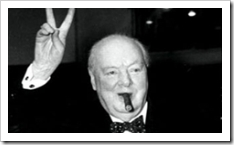
How much will you bid for Churchill’s partly smoked cigar?

Churchill could never have imagined that a partly-smoked cigar he discarded in an ash tray at Chequers Court more than 50 years ago would end up being offered for sale in a fine art auction. And the 12cm weed is expected to sell for up to £120.

I have no idea who has offered it for sale, or how it came to be in his/her possession. Why wasn’t it thrown out in the bin? Why was such a large amount discarded by the statesman? Was Churchill interrupted from his smoke by important business? Did he intend to re-light it later, only to discover it had been swiped by someone with an eye to profiteering? Do you regard it as an object d’art?

It comes with a typed note saying it was taken out of an ashtray at Chequers Court on February 21 1953; the auctioneers say they don’t have any corroborative evidence, but there’s seemingly no reason to doubt it.

I think I’ll wait for one of Maggie’s handbags to come under the auctioneer’s hammer!

August 30th, 2006

My screen test for TV

I’m heading off to London today for a screen test with a TV company, the first time I have ever done anything like this. It is for an exciting new programme which is due to be screened on Channel 4.

All will be revealed in due course, whichever way it goes, but I can tell you it is not Countdown or Deal or No Deal - and I will need my passport if selected.

August 29th, 2006

Where were Kennedy’s courageous colleagues?

It takes considerable courage to tell the truth, especially if you fear the future success of your political party could be at stake. Concealing the truth and taking the easy way out is never the answer.

But who really cared about what would happen to Charles Kennedy the man, as his drinking continued to spiral out of control? Why didn’t his colleagues intervene and force him to consider the deterioration of his health instead of colluding and covering it up?

Someone who has faced those demons and knows exactly what he went through is Veronica Callanan, one of my clients who runs a private drink and drugs clinic in Cambridge called The Development Centre. She is a recovered alcoholic, yet to meet her you would never imagine that she had hit rock bottom as a binge drinker. She is a stunning success story of how you can win the battle with booze, she knows it could happen to any of us.

Veronica has condemned Kennedy’s friends for not rallying round to confront him about his drinking. This is her response to the sorry saga:

“Alcoholism isn’t, and has never has been, a solitary ‘illness’, it is a condition that can worsen or be improved by the response of the people around them, particularly their family, most certainly their closest peers. Their collusion with alcoholism can actually worsen the condition

“One of the greatest tragedies of alcoholism is the number of people who surround an alcoholic and enable them to ignore the seriousness of the illness. Certainly, some alcoholics could receive help a lot earlier if they are allowed to feel the consequences of their actions which people around them have prevented them feeling because they are trying to support or help them. This is a gross miss-judgment on their part.

“Alcoholism is defined by the condition of denial, it is an illness that tells the alcoholic they don’t have an illness. Denial of this nature is often expressed in blaming outside factors for internal dissatisfaction or dysfunction, the job, the relationship, living arrangements, stress, perceived unfair treatment by others, lack of money etc the list goes on and on that alcoholics can blame their feeling of dissatisfaction on.

“The arguments of “I deserve a drink because this is happening to me” or “ You’d drink too if you had the day I had”, are just excuses that the alcoholic uses to continue drinking. In fact alcohol isn’t actually the problem, it is a symptom of the problem, alcoholism is actually the way someone thinks and feels, this being so unpleasant, that alcohol is used as a temporary release from that state, and so the problem continues. Alcohol is defined by feelings of fear and dissatisfaction that are almost impossible to articulate so are therefore buried.

“It’s unfortunate that in Charles Kennedy’s position, no one had the courage or integrity to confront him on what was clearly unacceptable behavior. It’s like the Emperor’s New Clothes, no one dared comment on what was obvious to everyone. He is another sad example of a man with promise and talent who was prevented from fulfilling his potential because of alcohol.

“You don’t need to drink everyday, get arrested, divorced, bankrupt to be an alcoholic, there are many high functioning alcoholics who indeed use their work to hide from themselves in order to not confront the reality of their situation. Alcoholism doesn’t go away, it doesn’t get better over night. It needs treatment, and the best form of treatment for an alcoholic is abstinence and a programme.

“The good news is that you can recover from alcoholism and recovered alcoholics are generally the most dynamic, brilliant people around. Once they are free from their alcoholic bondage , they are able to reach heights previously only dreamed of. When one’s internal world is in order, the external world will reflect this. If Charles Kennedy is able to successfully address his condition, he could potentially be one of the greatest leaders his party or indeed this country has ever known. If a man can address this problem and come out the other side with wisdom, humility, experience and self awareness then he has the potential to be a great man indeed”.

If you want to check out whether you have a drinking problem, then try Veronica’s test.

August 29th, 2006

David Mills and those "bad pennies"

David Mills, estranged husband of Culture Secretary Tessa Jowell who is to stand trial for alleged fraud, explains his demise after mixing with “one or two bad pennies, or in Berlusconi’s case, a bad pound”.

Janice Small was involved in breaking this story for Legal Business mag, which has an exclusive interview with Mills further pleading his innocence.

From what he says, he was a very trusting man who became mixed up with the wrong crowd. Would you buy a used car from him?

I only have this story on pdf and will send it to anyone interested.

August 29th, 2006

Would you like your medical info sent by text?


How would you feel if important medical info was sent to you by text or email? This is what a Suffolk hospital is considering to save on postage costs following Royal Mail’s new pricing system.

Although concerns about confidentiality have been raised, there is also the chance that vital info could accidentally be deleted by the recipient, causing distress and considerable inconvenience.

I expect it will be up to individuals to make up their own mind on this if the hospital goes ahead. I can see its attraction if it means getting news quicker. But is it old fashioned to still want a letter? Do medical letters get lost in the post?

While I can agree with using texts and emails for making hospital appointments, and I sympathise with hospitals having to make massive cash savings, ensuring the safe delivery of medical info to patients must remain a first class priority - even if second class stamps are used!

August 28th, 2006

Why Blair and Bush were wrong about Lebanon, by Terry Waite

Former Hezbollah hostage Terry Waite has joined critics who have condemned Tony Blair’s handling of the Middle East crisis. He knows more than most about Lebanon. It is 15 years since the former church envoy was released from captivity by militants in Lebanon.

In an interview with his local press (not available on-line due to the lack of Bank Holiday updates), the humanitarian explains why he believes Tony Blair and George Bush have got their policies wrong. He speaks fairly, recognising the dilemmas on all sides. Here are some extracts:

I don’t think it does any good to ask the question who started the war. It is futile. You have to say what causes this friction and it is fundamental injustice on all sides.

“I am not one of those people who believe the state of Israel can or should be eliminated, but at the same time, I don’t think they should be allowed to get away with many of the injustices they have perpetrated on the Palestinians.

“If a Jew from anywhere in the world wants to reside in Israel, they have automatic right of entry, but Palestinians have no right (to return to their former homes). In Lebanon, you have refugee camps with third generation Palestinians who have no right of return and no possibility of equal status in Lebanon.”

The report adds that Waite suspects American foreign policy is mainly decided by its economic interests and its desire to control oil. It seems that oil is at the heart of many wars.

“That is a very strong motive. Perhaps the decision has been taken in Britain that it is in our economic interests to go along with that. But it has done us enormous harm.

“I feel Tony Blair has failed to give the balanced leadership that is required at this time. Admittedly it is exceptionally difficult to deal in a balanced way with the Middle East, but he has succeeded in giving the impression that he is purely going along almost blindly with American foreign policy, which is mistaken.

“The Palestinian question will not go away. It has to be resolved. I don’t want to put the total blame on America and Israel. That would be unfair, there are grave difficulties in many Arab states themselves, but these are the symptoms of unresolved problems.”

He does remain optimistic and remembers thinking we would never see the end of apartheid or communism - yet they both happened.

Interestingly, the report adds how Waite was asked to stand as an anti-sleaze political candidate against disgraced former Tory MP Neil Hamilton, but he declined and Martin Bell took up the crusade instead. I think Waite would have made a great MP, though I imagine he would easily become very frustrated by attending endless committee meetings, being tied by endless paperwork and bureaucracy.

August 28th, 2006

More criminals on the loose if John Reid gets his way

John Reid If John Reid wants magistrates to use electronic tagging as an effective alternative to prison, I suggest tags are used that cannot be removed.

At the moment it is all too easy to slip the net and commit further crimes and the Home Office has not even kept vital records on this. This is a flawed system that has not proved itself.

Magistrates must despair at this kind of interference, being told to take the easy way out. Only serious suspects would be considered for jail. Let’s keep them there, let’s build more prisons.

August 28th, 2006

Meet a new blue female blogger

Welcome to a new female blue blogger - only this one wears a uniform and gives some interesting inside info about life on the beat .

PC Bloggs gives useful tips on what to avoid saying if you don’t want to get booked for speeding; certainly best not to blurt out that you pay their salary!
She is also conducting her own survey on police overtime as the much derided Home Office wants to slash this bill by 15%, despite the increasing terrorist threats and staff morale being at an all-time low with officers leaving the force left, right and centre, though there are some that still love their job.

I’m amazed that PC Bloggs can find the time to write a weblog with all the paper work and bureacracy they are faced with. But I like what she writes, getting the grassroots view about the life and work of a WPC.
By the way, if the police will not confirm an enquiry, it means “yes”. You read it here.