Ellee Seymour

MCIPR, PRESS CONSULTANT, JOURNALIST, POLITICAL AND PR BLOGGER.

Boris 1boris 17boris 16boris 12boris 13boris 15boris4boris2boris 6boris 7boris 9boris 11boris 3
February 29th, 2008

Social booking tags and a Daily Mugshot

I sometimes lie in bed and think how dull my life would be if I Geoff had never started writing my blog, meeting so many interesting people, making friends with virtual strangers (not as sad as it sounds), receiving great invitations and now looking forward to exciting new opportunities which are just around the corner.

Some of you may know I have Geoff to thank for this, he launched me and my blog and provides me with technical support. I can never thank him enough. Thanks also to Tim Almond for this.

So today I turned up on Geoff’s doorstep and took him out for lunch to one of his favourite local haunts, Le Gros Franck in Cambridge. On our way back to his house, we walked past Doug Richard a former Dragon from Dragon’s Den, he has offices nearby and I might see him there next week at a special event I have been invited to.

I had wanted Geoff to add a couple of social bookmarking tags to my site, but he surpassed himself by including a whole colourful array of pretty looking links at the bottom of my posts, including de.licio.us and StumbleUpon, as well as some I have never previously heard of.

I was also able to catch up with my fellow Cambridge Evening News colleague Boni Sones who runs the Women’s Parliamentary radio station and is staying with Geoff at the moment.

I declined Geoff’s suggestion to try one of his latest tekkie fads, but it does look fun, you might like to have a go yourself. It’s called Daily Mugshot and allows you to take a picture of your face every day (it has software which finds the eyes in the the newest picture, and aligns them with the eyes in the first picture. ) it stores the images and then allows you to play them back as a video. His pretty daughter Emily has signed up, but then I doubt she ever has a bad hair day …

*Just realised my headlines says “booking” instead of “bookmarking”. Ah well, it had been a long day.

February 28th, 2008

Prince Harry and the Taliban

image Should we worry about Prince Harry having some action in Afghanistan and firing at the Taliban? After all, he didn’t sign up to sit behind a desk all day.

My only concern is that his presence could attract a threat from terrorists and put the lives of his colleagues even more at risk.

Other than that, we should let him get on with doing “his bit” alongside his comrades and serve his country.

However, I’m not sure if that is going to be possible now news of his presence there has been made public.

February 28th, 2008

Will you pay 5p for a plastic bag?

imageA round of applause to M & S for charging food shoppers 5p for a plastic bag and giving the money to an environmental charity. Will you pay 5p? I bet you won’t. You will take a reusable bag. That has been the experience  in the Republic of Ireland, where a plastic bag levy was implemented in 2002.

It’s a hot topic up for discussion on Newsnight tonight.

I hope their researchers pick up on the image  fact that the UK government has taken the soft option on this, and how towns across the country are taking matters in to their own hands by introducing their own plastic bag ban. I hope their researchers take the trouble to find out how many towns have followed the pioneering and brave step of shopkeepers in Modbury, Devon, the first town to introduce their own ban last year.

imageI was very disappointed that David Miliband, even after visiting Ireland and seeing for himself how successful the ban was, came back and said he would be happy with a 25% reduction of plastic bags in the UK within 2 years, as opposed to the 90% plus reduction which the Irish managed. 

This is a subject close to my heart, it is something I researched for an academic paper in 2005 for which I was awarded a distinction. I image  highlighted the global concerns about how these flimsy bags clogged up rivers causing drought. I was aware of how deadly they could be to sealife - and indeed wildlife - if the bags were swallowed, as well as being a major littering problem. In 2002 I visited Dublin to research an article on this for an environment magazine and spoke to government officials and retailers, as well as shoppers, about its success.

What is clear is that large organisations and citizens in the UK are making their own decisions and being proactive because of our government’s inactivity. I can’t something of another issue where this is more evident. It’s real "Power to the People" stuff. There is lots more on this topic on the Abolish Plastic Bags blog.

And well done to the Daily Mail for sharing my views on this, six years on….

*While on the subject of the environment, you may like to read this article by Tony Juniper which questions how committed our government is to the environment. The plastic bag issue highlights it perfectly.

February 27th, 2008

The job I didn’t get

I was reading the latest story yesterday from the Campaign to  Protect Rural England and it reminded me of how I once applied for a job as their regional press officer, but didn’t get it.

It was a part-time job which paid peanuts. The interview involved writing a test press release and being grilled by three officers who had travelled from London to Cambridgeshire.

After having my two lovely sons, it was always important for me to be a mum first, to try and find work which fitted around school hours. Believe me, they are few and far between.

Prunella 016 So I was really keen to get this job and in the end it was between me and one other person, and they chose the other applicant because they felt I lacked formal campaigning experience, while I have always worked intuitively. What I didn’t lack, however, was imagination and creativity.

I was naturally disappointed because I felt it would have been a great organisation to work with as I share their concerns and beliefs about preserving our countryside.

However, I wasn’t without a job for long as within a week or so I was offered a press officer’s post with Cambridgeshire and Peterborough Joint Waste Strategy to consult with the public and stakeholders on how the region’s household waste should be disposed of. This led to me later working as Press Officer for the Eastern Region Slim Your Bin campaign, which was hugely successful.

My boss on the Waste Strategy was a lovely man called Bernard. A month after I started working with him, I learnt that the CPRE and its then president, one of our greatest actresses Prunella Scales, would be visiting Ely, close to where I live. I was curious to know who had trumped me for the job, so I devised a plan to find out. I knew Prunella was keen on recycling and I called the CPRE to ask if Bernard and I could go to the Ely event and talk to Prunella about the region’s waste and recycling.

I dressed up to the nines in my new lilac suit and proudly took BernardPrunella 013 along where I met up with one of the women who had interviewed me. She was stunned to see me there. Their new press officer was a wimpy looking guy with a limp handshake and, from memory, it wasn’t long before the job was readvertised.

Bernard and Prunella got along like a house on fire and I took some press photos for our campaign, which Prunella endorsed. Bernard was so thrilled, being an ardent admirer of hers, and he kept telling me his wife wouldn’t believe him. I later confided in Bernard the reason why I had planned the meeting, and he said he felt he got the best deal. We had lots of big smiles that day.

imageBut here is what happened next, it was so amazing for me. Also during that week, Prunella was also appearing at the Cambridge Arts Theatre with her husband Timothy West, a huge, towering figure of a man. I had already bought tickets and she invited me to join her and her husband in their changing room afterwards for drinks, which I did. They were wonderful, so very sweet - "darling this", and "darling that" - so lovey dovey together, I will never forget their kindness.

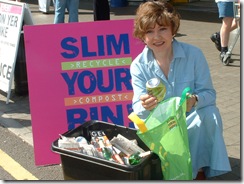
A couple of weeks later I had another brainwave and asked Prunella if she would launch one of our Slim Your Bin recycling roadshows which she agreed to do, in the very unglamorous location of Tesco’s car park, Bar Hill.  I have published a couple of the pics I took of her there, including one with a very chuffed Bernard. I had to liaise with the Tesco press office due to her advertising commitment with them, but they were very supportive and Prunella was magnificient. And all this cost us nothing, just a little imagination. And a bit of cheek!

I wonder if you have triumphed after losing a job you really wanted, if you turned it into something positive too.

My cloud certainly had a silver lining …..

February 27th, 2008

Did the earth move for you last night?

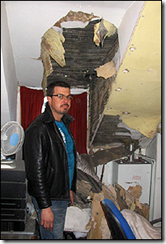
image Am I alone in having slept through last night’s earthquake, along with my two sons, while my husband who stayed over in Colchester was woken with an almighty jolt and a shaking bed, and my sister in Wisbech felt the tremors too, her wardrobe door flung open and everything around her shook and shuddered?

I was blissfully unaware of this chaos on my doorstep, said to be the biggest earthquake in 25 years. Did you sleep through it too, or were shaken to your very core and scared witless?

February 27th, 2008

Do you txt + drv?

I was really surprised when I read the findings of a Facebook studyimage conducted by the RAC Foundation on how almost half of Britain’s morotists txt + drv at the same time.

I’ve written the results in a press release for them which is published today and realise that I must be included in that figure, that I leave my mobile switched on when driving and will check any messages that ping through if I am waiting at traffic lights or a junction.

I now know better and shall not do it any more, but how many other drivers fall foul of this law too and do not realise it is an offence?

It’s also interesting to see how major organisations are using Facebook to conduct surveys. It is one of the hot topics up for discussion at this year’s Social Media Influence conference which I shall attend on 4 June. Formerly known as Blogging4Businees, it’s a must for anyone who needs to understand how social media can work with - or against - businesses today, how online conversations are ignored at their peril.

Here is the press release, do you text + drv too?

Almost half of Britain’s motorists regularly flout the law by texting and driving, putting themselves and other road users at risk, according to figures published today by the RAC Foundation.

A survey of 2,000 Facebook users revealed alarmingly that 45% of UK drivers text whilst driving, with only 11% of motorists turning off their phone or switching it on mute – leaving 89% of drivers open to the distractions caused by mobile phones. Research has found that if you use a mobile phone whilst driving, you are four times more likely to have a crash.

This survey marks the year’s anniversary of the change in law which penalises motorists with a £60 fine and 3 penalty points for using their mobile phone whilst driving, which includes texting and driving. It discovered that the young and techno savvy were more likely to text and drive in congested parts of the country, and that texting whilst driving differs throughout the UK. It is highest in London (53%), and Manchester (50%), and lowest in Aberdeen (31%), Edinburgh (36%), Bristol (36%) and Glasgow (38%).

The RAC Foundation plans to continue its innovative research into texting drivers following its survey, which highlighted that five distinct groups of texting drivers can be found on UK roads. They are:

  • Manic multi-tasking multimedia maniacs: 21% of this group found read and send texts in free flowing traffic. It is dominated by techno savvy men aged 18-24 who regard the phone as a personal extension, with texting an almost automatic reaction. The highest proportion of this group can be found in Manchester (26%), followed by London, Wales and Leeds (both 25% ?).
  • Opportunistic time optimisers: 19% of those surveyed read and/or send text messages when they are stuck in a jam. This delay may cause people to text, for instance to let others know they are going to be late. Women are more likely than men to fit within this group and this activity decreases with age. This texting approach was by far most common in London (24%).
  • Anti-action aware texters: This is the largest single group accounting for 44% of all those surveyed. This group will not text whilst driving, but will leave their phone audible. This may distract the driver or encourage them to alter their driving plan (i.e. stop to read the text) which could create road safety problems, especially if they stop to view a text at an inappropriate location. Women are most likely to be text aware, and this increases with age. Drivers in Glasgow (51%), the West Midlands (51%) and Bristol (51%) are most likely to fit within this category.
  • Casual communication perusers: This group accounts for a mere 5% of those surveyed. These drivers read their texts in moving traffic, but would not consider responding or sending messages whilst driving. This activity is most common in Manchester (7%), Glasgow (7%) and Newcastle (6%).
  • Virtuous vigilantes: 11% of those surveyed make up this final group of motorists. They responsibly switch off their phones or put them on mute to avoid distractions. Women are marginally more likely than men to fall into this category. Motorists in Aberdeen (19%), Edinburgh (16%) are particularly conscientious about these safety measures.

Elizabeth Dainton, Research Development Manager of the RAC Foundation, said the survey clearly demonstrated that a large proportion of UK drivers were breaking the law by texting and driving.

She said:

“Many young people may not be aware that it is illegal to text and drive and how it places them and other road users in potential danger. Urgent action is needed to address this increasing problem, especially as the ‘Y’ generation, who have grown up with technology and computers, begin to take to the road.

“It is really hard to do two things at once. The fact that using a mobile phone whilst driving means you are four times more likely to have a crash clearly shows how unwise it is. And if you have an accident whilst texting and driving, you can be prosecuted for not using due care and attention on the road.

“Our message is clear - do not text and drive. I strongly urge motorists to switch off their mobile phones when driving or put them on mute. Messages can easily be picked up once the journey has finished and it removes temptation to send or read messages. It also removes the mental distraction that can be caused by receiving a voicemail message.”

Update: We’ve had some excellent coverage from this, including coverage by the Daily Mail, ITN, the Press Association, Channel 4 News,  BBC, Glasgow Herald and motoring and cellular mags.

February 26th, 2008

Does Prozac work for you?

image There are some confusing headlines in today’s papers which will send the manufacturers of Prozac and other antidepressants in a spin.

A clinical trial has concluded that placebos worked as effectively as anti-depressants. Researchers found that the drugs had no more effect than a placebo for mildly depressed patients, and for most people suffering severe depression.

So does this mean that thousands of patients are taking these drugs, which could have severe side effects, unnecessarily? Are you, like me, confused about what it means?

A group of experts, led by Prof Irving Kirsch, from the Department of Psychology at the University of Hull, analysed 47 clinical trials using data released under Freedom of Information rules by the US Food and Drug Administration. They found little evidence of benefit when analysing both unpublished and published data from the drug companies.

Does these findings mean that antidepressants do not work? I don’t think that is what they were saying, they found that the anti depressants did work, but then so “did” the dummy drugs.

More than 31 million prescriptions for drugs such as Prozac were issued in England in 2006 - a 6% rise on the year before - and a record high, despite national guidance advocating alternative treatments. I wonder how doctors will view these results, it must be confusing for them too.

So does Prozac and other depressants work? Or should doctors be prescribing counselling and alternative treatment instead, such as exercise?

February 25th, 2008

Govt PR for maths, science and languages, and Uni drop out figures

image It seems government’s solution to make maths, science and languages more appealing for school kids is to hire PR agencies.

I find it absurd that Ed Balls’ Department for Children, Schools and Families is launching two major PR drives to encourage teenagers to study these subjects.

A report in the latest PR Week states how two PR agencies have been hired to improve the popularity of maths, science and languages. During a three-year campaign, Fishburn Hedges will target 13-17 year olds to show the attractive career opportunities that can result from studying maths and science - such as becoming lighting experts at music festivals and Formula One engineers.

This is what worries me, they seem to be dumbing down the relevance of two very important subjects. Is there a shortage of lighting experts at music festivals or motor racing engineers? Or is there a shortage of scientists to work on research projects to tackle climate change and other global issues? Will that be part of their message too?

Meanwhile, Band & Brown’s brief is to increase the number of young people studying modern foreign languages after the age of 14. The 15 month campaign will launch this summer.

This comes within days of a review announcing that speaking foreign languages in a GCSE exam was too stressful for pupils and could be dropped from the exam.

Instead of trying to understand the reasons why learning a foreign language is declining in popularity, as well as science and maths, Ed Balls is using taxpayers’ money on PR to try and influence school kids. Why not use this money, I imagine tens of thousands of pounds, on appointing more teaching staff, providing extra training if necessary, as well as briefing careers advisors on getting the right messages across?

Obviously, I’m all for positive and proactive PR, but it has to make sense, and this clearly does not.

*Also on the subject of education, I’ve been following reports image about university drop out figures reaching almost 25% with particular interest as my eldest son David is planning to go to uni in September.

It seems many students have been doing their calculations and worked out it’s not going to be worth their while financially, that the extra money they get as a graduate will not offset the £25,000 debt they may end up with at the end of their course.

Then there is the little contact time between student and lecturer. I visited several uni open days in the last few months, and it is not as high as the 14 hours quoted in this Sunday Times report. From memory, it was more 10-12 hours. This came as a big surprise to me, I was expecting more.

David wants to study Economics at Hull University which we visited again on Saturday. Economics graduates are estimated to be among the top wage earners once they enter the real working world. So hopefully there will be some financial security for David, and not just the worry of a huge debt around his neck.

Yes, I know Hull is John Prescott and Alan Johnson territory, but this will be the last thing on David’s mind as he enjoys student life. The university’s Business School is impressive and everyone we met seemed friendly and happy. I know several people who have been to Hull Uni and nobody has a bad word to say about it. And it’s also much cheaper there too, beer costs around £1.30 a pint, according to David’s research! His campus accommodation looks decent and, including a hot evening meal and cleaner, costs less than £90 a week. The bus fare is a fraction of what he pays in Cambridgeshire.

I do sympathise with unis struggling to attract good caliber students, of desperately trying to get students to sign up to boost their coffers. We visited one which said they would accept lower A’level results, which is why standards are dropping, and students can’t cope once they get there.

February 25th, 2008

We all love Brucie

There can’t be an octogenarian in the land who doesn’t envy image Bruce Forsyth’s energy and panache, his quick wit and adoring family.

There is lots we can learn from Brucie about old age, that music, laughter and love is the recipe for enduring happiness and good health. both physically and mentally.

I particularly liked the fact that at his star studded 80th birthday party held at the Dorchester, he invited his gardener and chauffeur along too, the ordinary people that make a difference to his everyday life. And how many 80-year-olds can include Miss England and Miss Peuto Rico as their guests!

Let’s hope his talents are rewarded along the same lines as Sir Michael Parkinson for giving so many people years of entertainment, for proving that you don’t need to be smutty to boost audience ratings, that you can still appeal to all generations of viewers at a time when ageism is rife. It’s personality that carries you through life.

So Brucie, I can’t resist saying it: “It’s nice to see you, to see you….

And let’s hope we will continue to see you for a few more years to come.

February 25th, 2008

Helping feed the world in future years

image Here is one very good reason why we need to promote scienceimage in our schools and keep our scientists in Britain - to work on ground-breaking, innovating research projects which will help feed the world’s expanding population in future years by tackling some of the most damaging and widespread pests, diseases and harsh environmental conditions which can devastate crop yields.

Twelve innovative and vital projects have received £7 million funding to do just that from the Biotechnology and Biological Research Council and the Department for International Development, including the National Institute of Agricultural Botany in Cambridge. I went to the launch last week and promised you an update about the awards. More than 250 proposals were received, and were whittled down to the final dozen.

NIAB will collaborate with the International Rice Research Institute, based in the Philippines for research on rice genetics that will lead to the creation of climate resistant strains of rice for Africa and Asia.

It is vital work. Rice is the staple food for over two billion people, but lack of water and disease limit its production across the developing world. There is an urgent need for new breeds of rice that can cope with changing climatic conditions and to improve food security across the developing world. Food prices are rising globally, and is beginning to cause severe hardship and suffering.

These are some of the other projects which also received funding:

Halting armyworm rampage with biological pesticide - the African armyworm is a major migratory insect pest, which feeds voraciously on cereal crops. Using a radical new solution, researchers from the UK, Canada and Tanzania will investigate the use of a naturally occurring virus in armyworms with a view to using it as a biological pesticide.

Defeating witchweed famine threat - subsistence crops relied on by billions are at constant risk of attack by the noxious parasitic plant witchweed. Researchers the UK, India and Senegal are identifying ways to protect the livelihoods of some of the world’s poorest farmers by developing resistant crops.

Improving food security for 500M people - Pearl millet provides food security for half a billion people in Africa and Asia. The crop is well adapted to harsh environments but climate change is threatening the predictable yields that subsistence farmers rely on. Scientists from the UK, India and Ghana will work to improve pearl millet’s genetic tolerance to drought.

Fighting nematode worms with fungus - Root-knot nematodes are microscopic worms that feed on plant roots, stunting their growth and causing yield losses of US$70 billion each year. UK scientists and their Kenyan colleagues are harnessing a natural soil fungus to destroy the worms’ eggs reducing damage to crops.

Reducing arsenic levels in rice - arsenic contamination of rice paddies is a major problem in many parts of Asia, caused by irrigation with arsenic contaminated groundwater, pollution resulting from base and precious metal mining and the use of municipal solid waste as fertilizer. Researchers from the UK, India, Bangladesh and China will look at types of rice which have lower take-up levels of inorganic arsenic to unravel the genetic basis for this desirable characteristic.

More bananas for Africa - nearly one-third of the sub-Saharan African population is severely under-nourished and 27% of the daily calories intake comes from plantains and other types of cooking bananas. However, up to 70% of plantains are often damaged or destroyed by mematode worms, which feed on its roots. Scientists from the UK and Uganda plan to breed plantains resistant to these worms which will be made widely available to growers to improve their yield and ultimately the dietary intake of millions.