Ellee Seymour

MCIPR, PRESS CONSULTANT, JOURNALIST, POLITICAL AND PR BLOGGER.

June 27th, 2008

Supermarket price wars

image Newsnight will ask its panel tonight: ” What kind of life can a chicken have had when it ends up sold at Tesco for £2?” The answer is obviously none.

It then continues to ask if anyone can afford to care when food prices are tripling and it costs nearly £75 to fill your car with petrol.

My answer to that is yes, we have to care and maintain public health standards. But at the end of the day, you will buy what you can afford. The days of cheap food have gone. Or have they? Tesco and Asda are waging a price war to entice shoppers, with Asda already selling ten staple items, including bread, eggs and butter, for only 50p from today.

I do not expect Asda is making a loss on these drastic price reductions, and if supermarkets can afford to do this now, how can they justify increasing these prices again and continuing to make vast profits at the expense of families struggling on the breadline? I appreciate that supermarkets have had to meet increased costs too, but now they must narrow their profit margin and tighten their belts just like the rest of us if they want to keep consumers on their side. I wonder if they predicted this a couple of years ago in their business plans.

Interestingly, Aldi, the German-owned discount chain, has experienced a 20 per cent rise in sales over the past four weeks – the fastest growth rate in Britain. The number of shoppers visiting its 400 stores has gone up by a quarter in the past three months. I can admit to being one of their new shoppers, though I still spent more than I wanted. Marks & Spencer, meanwhile, has suffered a 3.2 per cent fall in takings in its food halls in the past month.

So food is not just a political weapon, it’s also the cause of supermarket price wars, and this is a taste of what is to come. If you have any shopping tips on where and how to find best value, do share them please…

June 25th, 2008

How do we support our ME sufferers?

imageI know two women whose lives have been shattered by ME, and I can tell you their suffering was very real, and not “all in their minds”, as some might believe.

Myalgic Encephalomyelitis, or chronic fatigue syndrome, affects an estimated 250,000 people in the UK. I’m highlighting it today following a significant legal victory for two ME sufferers after a leading judge declared it was “in the public interestâ€? for the High Court to rule on claims that treatments being offered on the NHS are “potentially fatalâ€?.

Kevin Short, a university graduate from Norfolk, and Douglas Fraser, of London, a former professional concert violinist with the Scottish Philharmonic Orchestra, have both had their careers curtailed by the condition’s crippling effects. Both men were outraged when, last August, the National Institute for Health and Clinical Excellence (NICE) issued new guidelines for the diagnosis and management of ME.

They say that, in its guidelines, NICE refused to classify ME as “a disease of the nervous systemâ€?, as the World Health Organisation has done, and recommended treatments which they argue are “harmful to patients” or could even prove fatal.
Mr Fraser and Mr Short took their fight to have NICE’s decision overturned to London’s High Court.

Barrister Jeremy Hyam, for the two men, explained that NICE guidelines recommended that ME sufferers be treated with cognitive behavioural therapy (CBT) and graded exercise therapy (GET) in an effort to alleviate their symptoms, yet one sufferer collapsed and died coming out of a gym after taking part in the GET programme.

Mr Hyam argued NICE had failed to take into account any evidence apart from that unearthed by its controlled clinical trials, which he said were not extensive enough. NICE had made its recommendations “based on inadequate evidence” and “failed to apply rational and consistent diagnostic criteria”,

Mr Justice Cranston expressed doubt over whether it was the court’s place to rule on medical or scientific matters, but was in the end persuaded that legal issues of “great public importance” were at stake. Giving his judgement, and granting permission to seek judicial review, the judge said:

“There is no doubt that, as with any debilitating condition that a person may suffer, many of us will know someone, or be connected to someone who has ME or chronic fatigue syndrome. It is a serious condition and the two appellants in this case have suffered a great deal as a result of it.

“Given that there is this obvious clash between the bio-medical and the psychosomatic theories of the cause of this condition and the great public interest therein, it seems to me that this case ought to go forward to a full hearing.”

The case will now go ahead to a full High Court hearing at a date yet to be fixed.

A letter in today’s Eastern Daily Press from ME sufferer Linda Crowhurst said this ruling gave hope to all those afflicted by this devastating condition. She writes:

“I am severely affected and my ME needs go completely unmet in Norfolk. Luckily, I have a very supportive GP, who knows that my condition is neurological, but his hands are tied when it comes to referring me to consultants because there is not the interest, the knowledge, the understanding or the availability of biomedical clinicians to treat me. I am left with virtually nothing, no hope and, worse, no biomedical understanding to ease the pain, the numbness, the digestive, the autonomic and endocrine issues: the 50 plus symptoms that I have endured.

“I want to be able to access services in Norfolk as any other person with a chronic illness is able to do.”

Let’s hope this ruling will pave the way for more research into this terrible, debilitating illness.

June 23rd, 2008

Totally new Total Politics

image Iain Dale has taken political blogging to a new dimension by launching Total Politics, an essential internet resource for political animals like myself.

Total Politics is Iain’s brainchild and is also available as a printed edition which Iain hopes “will do for politics what GQ has done for men’s fashion”. Is that image a reference to the snazzy ties Iain favours?

The website will contain most of the content of each issue of the magazine. It also aggregates all the political and journalists’ blogs and I was interested to see that Labour bloggers (267) are ahead of Conservatives (268) by 1. It also hosts a collection of Political Quotations and a Political Speeches Database.

I would like to see the website include more links to worldwide political blogs so it becomes a unique source of leading international political blogs too. I would also like to see Total Politics encourage younger readers, to focus regularly on their political views and aspirations. We do have a youth parliament and these young people will be our future decision makers.

Iain is asking for feedback on the site, so do check it out. The magazine is available now at WH Smith and includes an exclusive interview with Gordon Brown, as well as the Australian political strategist Lynton Crosby. These are quality interviews which the mag will have to sustain to keep its readers hooked.

James Robinson tells us that copies of Total Politics, backed by Tory benefactor Michael Ashcroft, will be sent to every elected official in the land – from MPs to local councillors – giving it a controlled circulation of 23,000. But they also need to prove its viability by sales at the cash till.

I hope there are enough political enthusiasts to support this venture. And, of course, there is the irony of Iain promoting the printed media at a time when he enthuses the power of blogging. I don’t have a problem with that as I am an avid fan of the printed media.

The question is whether enough Spectator and New Statesman readers will buy it as well as their favourite political read. And if readers can get the content free online, what is going to persuade them to subscribe to a printed version? Will there be enough advertisers to make it profitable during these times of economic gloom? I hope the magazine includes some gossip too, after all, what’s politics without a few fun, bitchy comments?

Good luck Iain, I look forward to buying a copy, and thanks for including my link in your Political Blog Directory. I admire Iain’s courage in launching new political media ventures, in trying to engage all political parties and the public in interaction.

*Worth a read, Matt Wardman’s more detailed review of Total Politics.

June 22nd, 2008

Geoff’s Cambridge to Oxford walk

My dear friend Geoff who started me blogging is on his second image day of walking from Cambridge to Oxford, about 80 miles.

That’s a mere stroll in the park for Geoff, who is used to much longer and challenging routes across Europe, and often alone.

I don’t need to text him every day any more to check he is ok as he is in regular contact via Twitter and keeps his girlfriend Sally fully informed, who now joins him on some of his mammoth trips.

According to Geoff’s update on Twitter, last night was stormy and he slept in a tent after walking 49km, that’s 57463 steps. Let’s hope the weather is kinder tonight, but I know Geoff is used to roughing it in hostile conditions, he is not a wimp.

Wouldn’t it have been fun if someone had started the same walk from Oxford to Cambridge to see who would have reached their rival university city first? My money would have been on Geoff.

Meanwhile, Anne from Oxfordshire is visiting Sally in Cambridge, but their paths did not cross as she arrived the easy way on four wheels.

Take care Geoff…

June 20th, 2008

Meet Mick, who blogs about his brain injury

image I spent one afternoon this week sitting in an out-patients clinic run by a neurosurgeon at Addenbrooke’s Hospital, Cambridge for his brain injured patients in my role as a Headway trustee.

It was truly harrowing listening to so many personal stories of tragedy, how people’s lives have changed dramatically overnight.

The Cambridgeshire branch of Headway runs a unique service by having a representative based at the hospital and is allowed to sit in on these consultations, so she can then follow through by offering support from Headway. This is a very valuable partnership.

Most of the cases I heard involved men who had been assaulted. These were decent, ordinary guys who were either attacked at work or while out and about. A couple of them talked about difficulties with their employers when they returned to work as they still suffered memory loss, fatigue and headaches, but their bosses have little understanding about the challenges brain injured adults face when returning to the workplace. I would like to raise awareness on this important issue.

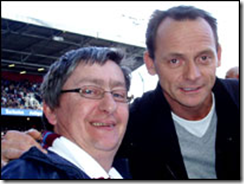
*One of our service users, Mick Jacobs, who is pictured with East Enders actor Perry Fenwick, has started writing a blog describing how he is recovering from his motor bike accident which left him brain injured. It is hosted by BBC Radio Cambridgeshire and is to featured by BBC Look East too. This is one of his extracts:

My case worker got me coming to HEADWAY CAMBRIDGESHIRE, after a lot of persuasion, and I’m glad she did. I used to think I was the only one like this. But there are so many people, all in the same boat, and they are all really great. I have made loads of friends in the short time I have been here, which has been about two months.

The future is going to be challenging. Not only for me, but more for Rose my wife and kids as they are also involved in my head injury. Because it just don’t affect the one person involved. It affects the whole family.

I never fail to be amazed by the strength and courage that people like Mick have in times of such terrible adversity. I liked his introduction, and hope to one day meet him and his wife Rose:

My name is Mick Jacobs, aged 44. I got married 22 years ago to Rose, who I call ‘My roll of sellotape’, because she stops me from falling apart.

June 20th, 2008

Do you fancy eating chlorinated chicken?

My MEP Robert Sturdy was among Conservative spokesmen who led the vote against allowing US imports of chlorinated chicken in the EU – a practice banned in Europe. Yet the British government was the only country which turned a blind eye to this.

Robert is the Conservative international trade spokesman and his concerns were based on how meeting American demands would flout present strict public health standards.

The Commission had proposed allowing businesses to use four currently banned anti-microbial substances to decontaminate poultry carcasses following pressure from the US, even though the EU has had a ban on US chlorinated poultry since 1997. American producers use low-concentration chlorine to wash chickens before selling them.

Robert said:

“This has nothing to do with banning American poultry, it is about them meeting our present public health standards which have been set for a reason. There is no room for compromise when it comes to ensuring food standards in the EU remain the highest in the world. This could pose a risk to public health and loss of confidence in the product.

“And I wonder why the British government has failed to support the retention of the ban – the only country out of 27 which abstained during a recent vote on importing American chlorinated chicken. Could it be pressure from supermarkets to provide cheap food, or wanting to keep the Americans happy?”

I personally wondered about the air miles too, why do we need American imported chicken – chlorinated or not? Shouldn’t we be supporting the British poultry industry which has suffered over the last year or so?

Wisbech 001

*This picture is nothing to do with chickens, it is my lovely sister Rosalind who has a dress shop in Wisbech and met Robert to discuss Chinese imported clothes.

June 18th, 2008

How the rosemary plant could provide a "green" solution to oil-based products

Dr Lydia SmithI’ve just issued a press release describing how the humble rosemary plant could revolutionise the way that some oil-based products are made, providing a “greenâ€? alternative to the synthetics and fossil fuels which are presently used.

Research scientists at the National Institute of Agricultural Botany in Cambridge have joined a group of leading industry and research partners to determine the feasibility of using the environmentally friendly antioxidants (AO) extracted from rosemary plants for the production of cosmetics, plastics and lubricants.

It has attracted lots of media interest, including BBC Look East, and Dr Lydia Smith, (pic), who is leading this project has given several follow-up interviews. We are hoping for some national coverage too.

It’s a fascinating project as present evidence suggests that there are relatively large quantities of strong AOs in the foliage of rosemary which could be extracted and used for other purposes besides culinary. Rosemary extract is increasingly under scrutiny for its AO properties. Like other AOs, it inhibits and fights free radicals.

The cutting-edge project is described as “an opportunity to enable the totally green supply of lubricants, cosmetics/health products and polymers, especially packaging”.

Dr Smith said the potential of this project was far reaching, and could really change the way oil-based goods were produced, enabling “greener� alternatives to be used instead of synthetics and fossil fuels.

So next time you use the rosemary plant in one of your recipes, just imagine that it could one day be grown as a crop by UK farmers for its versatility, as an ingrediant in some cosmetics in place of petro-chemicals to improve their shelf life, in the production of plastics used for food packaging and to provide less toxic lubricants than the oil-based alternatives.

Members of the group working with NIAB on this collaborative project, which is partly sponsored by Defra through the Renewable Materials LINK programme, are Bangor University Composites Centre; Aston University; Boots-Alliance; Co-operative Retail; Croda International; Frontier Agriculture; Horticultural Development Council; Industrial Co-polymers; Lubrizol and Uponor Housing Solutions Limited.

June 16th, 2008

My new MacBook

image

I’ve bought a new glossy MacBook so I can use its renowned applications to produce some great videos for my clients.

I found Vista pretty hopeless for publishing YouTube, but noticed how slick and effortless it was to do this from Geoff’s Apple Mac.

It’s totally different to what I have been used to, but I now feel totally reassured about making full use of its many applications after learning about their personal one-to-one training sessions, one hour a week for a whole year, for only £79. I didn’t think it was true, how could it be so cheap?

So I called their newly opened Grand Arcade store in Cambridge yesterday and Jason confirmed that it was true, and unsurprisingly, that it was very popular. Jason told me their staff are highly skilled and creative and include a film maker who will be able to guide me through any difficulties. I signed up on the spot and booked my first lesson for later this week. What an incredible bargain. I also signed up for one of their free workshops to learn how to make iMovies.  I want to know more about iPhoto’s fabulous features too. And I also like the look of iLife.

What I would like to know is whether I should use NeoOffice as my main office software which I have downloaded, or use Microsoft Office for Mac users, which doesn’t seem to be highly rated.

If you have a Mac, what are your favourite features, and what office software do you use?

*P.S. I met a Microsoft exec at a recent social media event and he told me they have have three AppleMacs in his house – he owns one and his wife has two!!

June 14th, 2008

Who not to invite to weddings

When I married, my husband’s family were not keen to invite image children to the wedding because his side included many cousins with young offspring, most of whom he rarely saw. My side of the family is much smaller and nephews and nieces were invited as my attendants.

I did regret going along with their decision because I like to see different generations meeting up at weddings. Why are we so intolerant of childish noise and excitement?

And children were  not invited to a wedding I went to last weekend, where the bride unusually wore black, except for the two tiny attendants. She was marrying her second "man cub", her husband is more than 20 years her junior.

Iain Dale gets hitched tomorrow in a civil partnership in a castle image to his partner of 13 years, John Simmons. But the 100 chosen guests, among them David Davis – ("perhaps we might have a whip round and and ask the rest of the guests to contribute to his campaign!") -do not include the partners of their friends if they do not know them.

This is most unusual and I wonder if it could lead to complications on their special day. This is what Iain says about it in his report in today’s Eastern Daily Press:

"I have lost count of the number of people who have emailed or rung and asked if they can bring so-and-so. I’m too polite to say, well if we wanted to invite them, their names would have appeared on the list."

Because Iain couldn’t explain this, does it mean he will end up with extra guests who haven’t fully understood?

He also tells readers that civil partnerships was one of the few real achievements of the Blair government, and that stable relationships, whether straight or gay, are a good thing.

I certainly agree with that, and have joined the 200 plus readers who posted a comment wishing Iain and John every happiness. I hope the sun shines on them, unlike the showers which Colleen and Wayne had in Italy during their nuptials this week.

At the end of the day, everyone should decide for themselves how they want to tie the knot and who to invite. So on the subject of weddings, what is the most unusual one you have attended and how do you keep guest numbers down without upsetting anyone. Have you ever been excluded from a wedding invite like this? And what is your view of civil partnerships?

June 10th, 2008

Off to Cereals 2008

Agriculture faces many challenging demands as it adapts to today’s environmental conditions and climate change. What is the image impact of growing crops for biofuels? How sustainable are our crops in the UK? What can we do to help farmers in developing countries suffering severe drought stress and food shortages?

Also most important, at the end of the day, are farmers able to make a decent living? How are they diversifying to keep their heads above water? Will we one day have a shortage of farmers in the UK?

I shall be leaving soon to attend Cereals 2008 and join the National Institute of Agriculture Botany there. I hope to learn some of the answers to these important questions. It is the leading event for the arable industry and is being held near Lincoln. It is expected to attract 22,500 professional farmers and industry experts over two days.

It’s my first visit to the show, and I hear it is really good fun too…