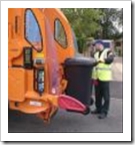
Norfolk challenges Government over wheelie bin bugs
Posted by Ellee on Oct 19, 2006 in Uncategorized | 10 commentsIt’s interesting how everyone is now talking about rubbish and how it should be disposed of. It is a very hot topic because if the UK fails to
meet its recycling targets, then it will be heavily fined.
And now the Government has no choice but to act tough because it failed to deal with household waste and landfill diversion over the last decade, it failed to communicate with householders and get their support, our landfill sites are rapidly filling up, nobody wants incinerators – so heck, what other alternatives are there?
The microchipped wheelie bin seems to be the answer to their prayers – but one group of Norfolk councillors have made it plain what Tony Blair can do with them. And with bonfire night coming up shortly, the mind boggles!
Rebel councillors in South Norfolk are determined to fight any attempt to force them to use “bug bins“, even on a trial basis. They have urged other councils to stand their ground and refuse to take part in pilot schemes. They refuse to impose a pay-by-weight tax on their residents who can’t afford it.
So what does Minister Miliband say about this? How is he engaging with the public? Why, surprise surprise, there isn’t a word on this controversial subject that has made national headline news and created a very negative image for the scheme. His site looks even more dreary than ever.
Just to show you how poor the UK is at recycling (or how badly the Government has implemented it), here are the figures, we are third from bottom:
WASTE RECYCLED IN EU
Netherlands: 65%
Austria: 59%
Germany: 58%
Belgium: 52%
Sweden: 41%
Denmark: 41%
Luxembourg: 36%
Spain: 35%
Ireland: 31%
Italy: 29%
Finland: 28%
France: 28%
UK: 18%
Greece: 8%
Portugal: 3%
Source: IPPR
So let’s give the Government a hand with this, do you have any innovative ideas to boost recycling? For example, I have heard that disposable nappies are recycled in The Netherlands, the EU’s good boys, they are collected from the kerbside and dismantled and given a new lease of life.
Or should we reward good recyclers with discount shopping vouchers, like they do in America? What are your ideas, or examples of good practice, that we could follow too?


Tim, I haven’t seen a Ferrari on the scrap heap, but a friend of mine has a Porsche that is heading that way. These Government targets are not driven by profits – just weight – that’s why local authorities prefer to collect a bagful of garden waste and have it composted rather a bag full of plastic bottles.
Rubbish is a resource and the saying that “where there’s muck there’s money is so true”. If we can’t reduce our waste, then we should re-use or recyle it, and there’s no reason why it can’t be done at a profit too. Did you hear about the world’s richest woman in China who made her fortune from waste paper? See http://www.timesonline.co.uk/article/0,,3-2399577,00.html
And Corus, just sold to an Indian company for £4 billion, http://www.thisismoney.co.uk/investing-and-markets/article.html?in_article_id=413752&in_page_id=3
also recycles steel: http://www.corusgroup.com/en/responsibility/cspr/
It’s obviously a very profitable market, and will become increasingly so as the targets increase in future years.
Ellee, this is my point. It isn’t a problem.
When things are worth money to recycle then people do it for the profit. How many Ferraris have you seen at the car cushing plant recently?
When it isn’t profitable to recycle, then we shouldn’t recycle. Remember, profit is the economy’s way of telling us we’re doing the right thing!
Tim, Did you notice Portugal was at the very bottom of the list? How are they tacking this problem? Are they micro-chipping wheelie bins there?
It’s true that reycling is expensive, but then we are a very consumer orientated society which buys and throws away too much, retailers need to drastically reduce packaging. Following on from your last point, I think councils should collect large unwanted household items free or charge which they could take away and sell at their own recycling centres, giving the proceeds to an environmental fund.
What we need is a lot less recycling rather than more. Remember your basic economics. If we’re making a loss doing something this is the Universe’s way of telling us we shouldn’t be doing it.
Recycling costs more than landfill. Thus we shouldn’t be doing it.
Think of it this way. If we really were getting lots of valuable materials from the recycling process then hte local council would be paying you to pick up those valuable materials, would they not?
Is it really that easy to remove them? I wonder what the point of them is, then…
Cityunslicker, glad to hear you share my views. Incinerators are not a necessary evil, but can be very productive in supplying electricity – and they are totally different today from their predecessors.
Alan, I have heard it is easy to remove these bugs, in fact, I believe that’s what has happened to half of them delivered to homes in Bournemouth.
Your points are all most valid Ellee. we still need incinetators though as they are a better alternative than nuclear power and help to reduce landfill.
Mixed recycling would be a nirvana. Let’s hope the Toris get behind it.
With a little know-how, 30 minutes of messing and a £7.99 disposable camera, it’s possible to render the “bug” in the wheeliebin absolutely useless – with no visible sign.
Cityunslicker, We will always need incinerators because there will always be a residue, but the public detests them, just like nuclear power.
On recycling, it’s not just a matter of colour coding, it needs to be simplified. Different authorities have different systems, some use bags, others bins and boxes and it’s very confusing. Some people simply don’t have the space in their homes to accommodate all these recycling boxes, so this needs to be considered too, larger families should have larger boxes, single people and the elderly could get away with smaller sizes.
Also, there is no reason (except we are behind the times here in the UK) why all the recyclables can’t go in one box. C-mingled recycling facilities are now becoming more widely available and means householders should not have to separate their recyclables.
Recycling is a favourite topic of mine, I have actively worked on promoting recycling in East Anglia – and it is one of the top recycling areas in the country.
Slighlty off note, but to reduce landfill as well as recycling we need to incinerate the more dangerous waste; this has the happy byproduct of producing power. To get more small incinerators though needs a change in the planning law.
On Recycling, if the council gave everyone enough bins to sort everything easily, colour coded say, then more people would recycle. They also need to collect more often.
The key is to take the pain away so that the even the idle will go along with it.
Fascist policing of recycling will not be the answer, as you rightly point out.